Thema 1
English follows Dutch
Inleiding over Nikhef als samenwerkingsverband tussen NWO-I en zes universiteiten. Informatie over Theorie en Experiment, alsmede Techniek. Maatschappelijke impact. Hoogtepunten deeltjes- en astrodeeltjesfysica. En de geschiedenis van Nikhef.
Introduction about Nikhef as a partnership between NWO-I and six universities. Information on Theory and Experiment, as well as Engineering. Societal Impact. Highlights of particle and astroparticle physics. And the history of Nikhef.
Als Nationaal instituut voor subatomaire fysica onderzoekt Nikhef de elementaire bouwstenen van de materie en het universum, hun onderlinge krachten en de structuur van ruimte en tijd.
Nikhef heeft 11 onderzoeksprogramma’s, van theorie en experimenten tot technische programma’s, en beschikt over eigen technische afdelingen met labs en werkplaatsen. Sinds 2026 heeft Nikhef ook een Artificial Intelligence themagroep.
Nikhef werkt wereldwijd samen in grote experimenten op het gebied van de deeltjes- en astrodeeltjesfysica.
______
As the National Institute for Subatomic Physics, Nikhef investigates the elementary building blocks of matter and the universe, their mutual forces and the structure of space and time.
Nikhef has 11 research programmes, from theory and experiments to technical programmes, and has its own technical department with labs and workshops. Since 2026, Nikhef also has an Artificial Intelligence theme group.
Nikhef collaborates worldwide in large experiments in particle and astroparticle physics.
Bij Nikhef werken meer dan 450 mensen, afkomstig uit zo’n 60 landen, waarvan ongeveer:
– Wetenschappelijke staf: 105
– Technici: 90
– Promovendi: 135
– Postdocs: 55
– Ondersteunende staf: 55
– Directeur: Prof. Jorgen D’Hondt
(Per juni 2026)
Nikhef is een samenwerkingsverband tussen de institutenorganisatie van NWO (NWO-I) en zes Nederlandse universiteiten.
______
Nikhef employs more than 450 people, from about 60 countries, including approximately:
– Scientific staff: 105
– Technicians: 90
– PhD candidates: 135
– Postdocs: 55
– Support staff: 55
– Director: Prof. Jorgen D’Hondt
(As per June 2026)
Nikhef is a partnership between the Institutes Organisation of NWO (NWO-I) and six Dutch universities.
Het onderzoek van Nikhef vindt plaats in experimenten bij deeltjesversnellers als de Large Hadron Collider (LHC) op CERN bij Genève en met detectoren voor kosmische straling, neutrino’s, donkere materie, zwaartekrachtsgolven en speciale elektroneigenschappen.
De experimentele onderzoekslijnen gaan hand in hand met theoretisch onderzoek, grensverleggende R&D voor toekomstige detectoren en de ontwikkeling van krachtige rekenmethodes en dataverwerking.
__________________
Nikhef’s research takes place in experiments at particle accelerators such as the Large Hadron Collider (LHC) at CERN near Geneva and with detectors for cosmic rays, neutrinos, dark matter, gravitational waves and special electron properties.
The experimental lines of research go hand in hand with theoretical research, pioneering R&D for future detectors and the development of powerful computational methods and data processing.
Nikhef heeft drie eigen technische afdelingen voor Mechanische Technologie, Elektronica Technologie en Computer Technologie. Zij ontwikkelen, ontwerpen en bouwen onderdelen en systemen die essentieel zijn voor de experimenten waaraan Nikhef deelneemt. Het instituut heeft in Amsterdam grote werkplaatsen en labs voor het technische werk.
Onderzoek op het gebied van deeltjes- en astrodeeltjesfysica is altijd op de grens van wat technisch haalbaar is. Nikhef- technici zijn daarom ervaren in state-of-the-art technieken en werken nauw samen met industriële partners, om te leren en om de eigen kennis te delen.
_____________________________
Nikhef has three in-house technical departments for Mechanical Technology, Electronics Technology and Computer Technology. They develop, design and build components and systems that are essential for the experiments Nikhef participates in. The institute has large workshops and labs in Amsterdam for the technical work.
Research in particle and astroparticle physics is always at the frontier of what is technically feasible. Nikhef technicians and engineers are therefore experienced in state-of-the-art techniques and work closely with industrial partners to learn and to share their own knowledge.
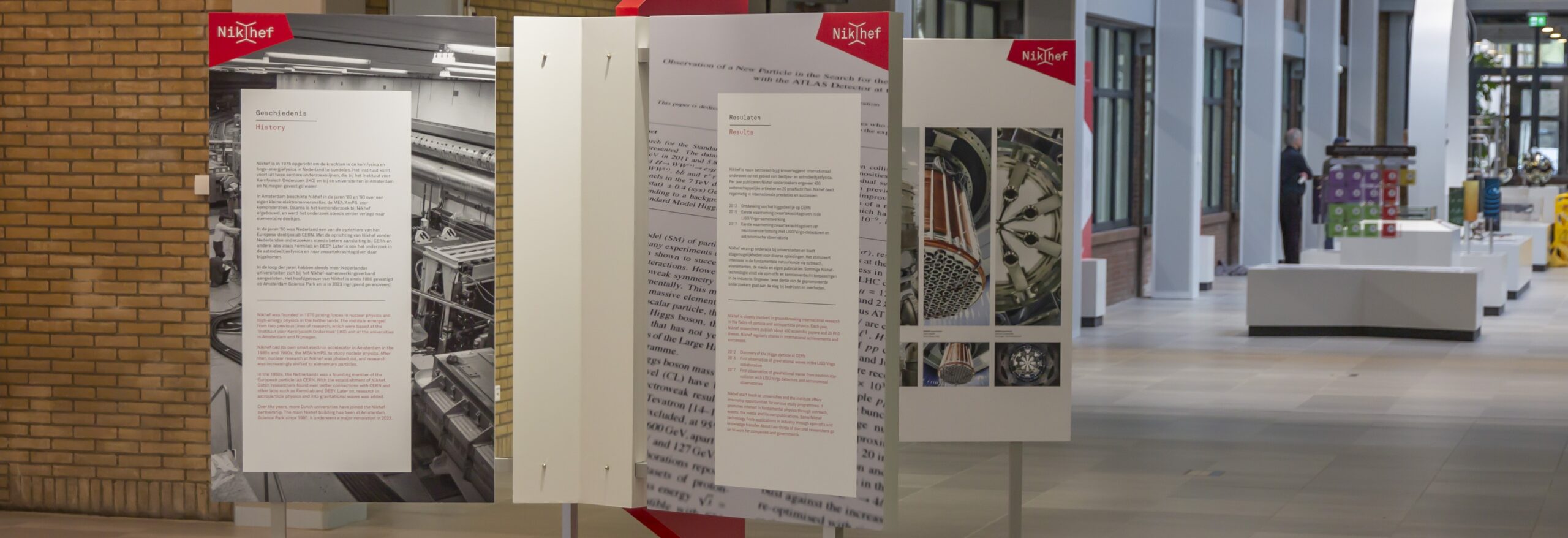
Nikhef is in 1975 opgericht om de krachten in de kernfysica en hoge-energiefysica in Nederland te bundelen. Het instituut komt voort uit twee eerdere onderzoekslijnen, die bij het Instituut voor Kernfysisch Onderzoek (IKO) en bij de universiteiten in Amsterdam en Nijmegen gevestigd waren.
In Amsterdam beschikte Nikhef in de jaren ’80 en ’90 over een eigen kleine elektronenversneller, de MEA/AmPS, voor kernonderzoek. Daarna is het kernonderzoek bij Nikhef afgebouwd, en werd het onderzoek steeds verder verlegd naar elementaire deeltjes.
In de jaren ’50 was Nederland een van de oprichters van het Europese deeltjeslab CERN. Met de oprichting van Nikhef vonden Nederlandse onderzoekers steeds betere aansluiting bij CERN en andere labs zoals Fermilab en DESY. Later is ook het onderzoek in de astrodeeltjesfysica en naar zwaartekrachtsgolven daar bijgekomen.
In de loop der jaren hebben steeds meer Nederlandse universiteiten zich bij het Nikhef-samenwerkingsverband aangesloten. Het hoofdgebouw van Nikhef is sinds 1980 gevestigd op Amsterdam Science Park en is in 2023 ingrijpend gerenoveerd.
______________
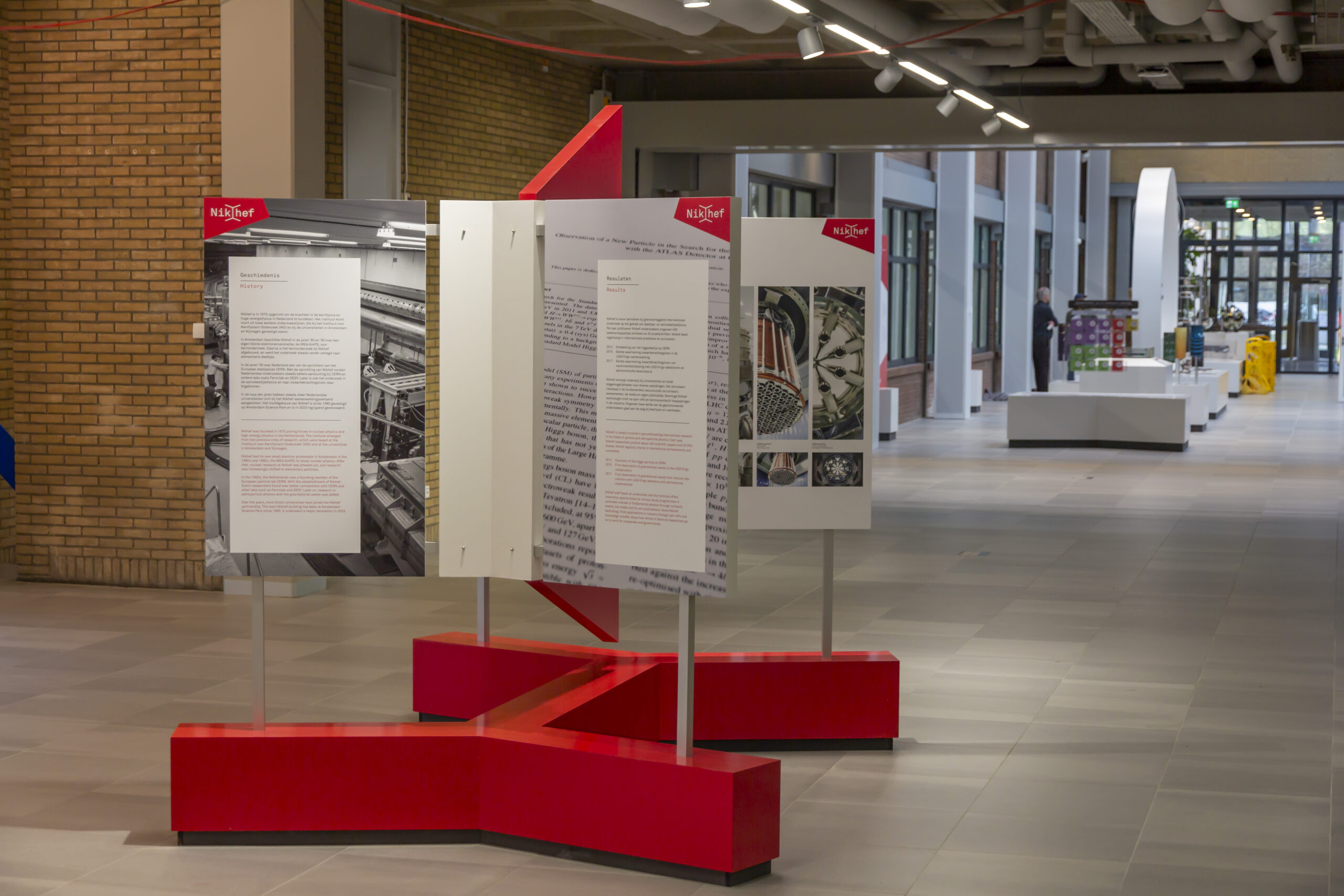
Nikhef was founded in 1975 joining forces in nuclear physics and high-energy physics in the Netherlands. The institute emerged from two previous lines of research, which were based at the ‘Instituut voor Kernfysisch Onderzoek’ (IKO) and at the universities in Amsterdam and Nijmegen.
Nikhef had its own small electron accelerator in Amsterdam in the 1980s and 1990s, the MEA/AmPS, to study nuclear physics. After that, nuclear research at Nikhef was phased out, and research was increasingly shifted to elementary particles.
In the 1950s, the Netherlands was a founding member of the European particle lab CERN. With the establishment of Nikhef, Dutch researchers found ever better connections with CERN and other labs such as Fermilab and DESY. Later on, research in astroparticle physics and into gravitational waves was added.
Over the years, more Dutch universities have joined the Nikhef partnership. The main Nikhef building has been at Amsterdam Science Park since 1980. It underwent a major renovation in 2023.
Nikhef is nauw betrokken bij grensverleggend internationaal onderzoek op het gebied van deeltjes- en astrodeeltjesfysica. Per jaar publiceren Nikhef-onderzoekers ongeveer 450 wetenschappelijke artikelen en 20 proefschriften. Nikhef deelt regelmatig in internationale prestaties en successen.
2012 – Ontdekking van het higgsdeeltje op CERN
2015 – Eerste waarneming zwaartekrachtsgolven in de LIGO/Virgo-samenwerking
2017 – Eerste waarneming zwaartekrachtsgolven van neutronensterbotsing met LIGO/Virgo-detectoren en astronomische observatoria
2025 – Waarneming van meest energetische deeltje
Nikhef verzorgt onderwijs bij universiteiten en biedt stagemogelijkheden voor diverse opleidingen. Het stimuleert interesse in de fundamentele natuurkunde via outreach, evenementen, de media en eigen publicaties. Sommige Nikhef- technologie vindt via spin-offs en kennisoverdacht toepassingen in de industrie. Ongeveer twee derde van de gepromoveerde onderzoekers gaat aan de slag bij bedrijven en overheden.
____________
Nikhef is closely involved in groundbreaking international research in the fields of particle and astroparticle physics. Each year, Nikhef researchers publish about 450 scientific papers and 20 PhD theses. Nikhef regularly shares in international achievements and successes.
2012 – Discovery of the Higgs particle at CERN
2015 – First observation of gravitational waves in the LIGO/Virgo collaboration
2017 – First observation of gravitational waves from neutron star collision with LIGO/Virgo detectors and astronomical observatories
2025 – Observation of most energetic particle ever
Nikhef staff teach at universities and the institute offers internship opportunities for various study programmes. It promotes interest in fundamental physics through outreach, events, the media and its own publications. Some Nikhef technology finds applications in industry through spin-offs and knowledge transfer. About two-thirds of doctoral researchers go on to work for companies and governments.
Bij het Nationaal instituut voor subatomaire fysica Nikhef worden baanbrekende innovaties in de wetenschap en de technologie gecombineerd. Daarmee draagt Nikhef bij aan toonaangevende instrumenten, experimenten en ontdekkingen in de deeltjesfysica wereldwijd.
Een fraai voorbeeld van deze succesvolle combinatie van wetenschap en technologie is de VELO-detector. Deze door Nikhef en andere instituten gebouwde Vertex Locator staat centraal in het LHCb-experiment op CERN, dat speurt naar verschillen tussen materie en antimaterie.
De VELO lokaliseert met micrometerprecisie de botsingen van protonen in de LHC-versneller. Hierdoor worden de exacte beginpunten van deeltjessporen vastgesteld, wat nodig is om deeltjes en antideeltjes waar te nemen en te analyseren.
Deze oorspronkelijke VELO-detector werd in de periode 2010-2018 gebruikt, en is nu vervangen door een nieuwe versie.
______
At Nikhef, the National Institute for Subatomic Physics, groundbreaking innovations in science and technology are combined. In this way, Nikhef contributes to world-leading instruments, experiments and discoveries in particle physics.
A fine example of this successful combination of science and technology is the VELO detector. This Vertex Locator, built by Nikhef and other institutes, plays a central role in the LHCb experiment at CERN, which investigates differences between matter and antimatter.
VELO localises proton collisions in the LHC accelerator with micrometre precision. This allows the exact starting points of particle tracks to be determined, which is necessary for observing and analysing particles and antiparticles.
This original VELO detector was used from 2010 to 2018, and has now been replaced by a new version.

